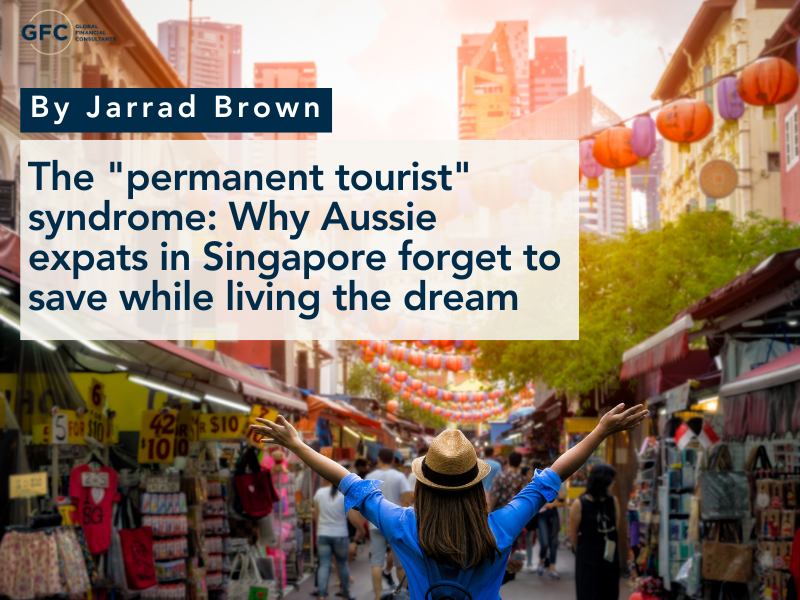
The “permanent tourist” syndrome: Why Australian expats in Singapore forget to save while living the dream
Global Financial Consultants
By Jarrad Brown
Leaving the sunny shores of Australia for the bustling city of Singapore is a rite of passage for many ambitious professionals. Many are drawn to the fact that Singapore often offers a promising career, a gateway to Asia, and lower taxes than in Australia. It is a land of rooftop cocktails, weekend hops to Bali, and a level of convenience that makes life back home feel a bit, well, suburban.
However, beneath the gloss of this tropical paradise, a peculiar phenomenon takes root. Let’s call it the “Permanent Tourist” syndrome. It is that state of mind where you feel like you are on an extended holiday rather than building a life. For many Australians, this mindset leads to a startling reality: they could be earning more than ever but saving less than they did in Sydney or Melbourne.
The impact of lower taxes
When you compare a top-tier Australian salary with its Singaporean equivalent, the difference in take-home pay can be significant. Without the heavy lifting of Australian income tax brackets, your bank account looks remarkably healthy on the first of the month.
The trap is thinking that this surplus is “free money.” In Australia, the system forces a level of discipline. Your superannuation is handled before you see a cent, and the high cost of living often dictates a stricter budget. In Singapore, that discipline is entirely on you. Without the safety net of the Superannuation, many Australians can treat their entire pay packet as disposable income.

The Lifestyle Inflation Trap
Singapore is designed to be enjoyed, and it is very easy to get swept up in the “expat bubble.” You might start with a modest condo, but soon you could be eyeing a larger house or a high-floor apartment in a prime district. Then there are the “small” luxuries that become non-negotiable: the weekly helper, the premium gym membership, and the frequent fine dining.
This lifestyle inflation is often fuelled by a short-term mentality. Because many expats view their time in Singapore as a temporary stint, they feel justified in spending big to “make the most of it” while they can. The problem is that a few years can easily turn into a decade. By the time you look at your long-term savings, you might realise you have spent years of potential wealth on experiences that have left you with great memories but a thin retirement fund.
The Great Rental Squeeze
For a long time, the math of living in Singapore worked out well for most. Even with high expenses, the tax savings covered the gap. But the landscape has shifted recently with significant rises in the cost of accommodation.
Some residents have faced rental hikes that are quite substantial in a single renewal cycle. This isn’t just a minor inconvenience; it is a fundamental change in the cost-benefit analysis of living in the city. For many Australians, the “Permanent Tourist” lifestyle is being hit by a cold bucket of reality. When your rent jumps by a large margin, those frequent luxury getaways suddenly feel a lot less affordable.
The global competition for talent means Singapore is still a top destination, but it is no longer the “easy win” it once was financially. If you aren’t careful, the entirety of your tax savings could be swallowed up by your housing costs before you even have a chance to think about your future.

Why We Make Excuses
It is human nature to justify our spending. We tell ourselves that we are “investing in networking” when we go for expensive drinks, or that we “deserve” the luxury travel because of the long hours at the office. We hear the common excuses on a regular basis:
- “I’ll save when I move back to Australia.” The “I’ll start tomorrow” logic is a dangerous game. Every year you don’t save in Singapore could be a year of lost compound growth.
- “The cost of living here is just too high.” While Singapore is expensive, it is often our choices rather than the baseline costs that drain funds.
- “I’m still young; I have plenty of time.” Time is a valuable asset in wealth creation. Overlooking your high-earning expat years is a hurdle that can be hard to overcome later.
The “Settling Down” Delusion
The quickest way to lose money as an expat is to fail to settle down financially. Many Australians live in a state of perpetual transition. They might not buy furniture because they “might leave next year,” so they rent expensive serviced apartments instead. They might not look into investment options because they don’t yet understand the local market, so their cash might be sitting in a low-interest savings account, losing value to inflation.
Living like a tourist means spending like a tourist. To break the syndrome, you have to start treating Singapore like a home, not a hotel. This means setting up a budget that accounts for the lack of a forced pension scheme and being realistic about what “living the dream” actually costs.
Three Golden Rules for the Australian Expat
If you want to enjoy the Singapore lifestyle without sabotaging your future, there are a few principles you could consider adopting.
1. Pay Yourself First
In Australia, your employer does this for you via superannuation. In Singapore, you have to be your own manager. You could decide on a percentage of your salary and move it into a separate investment or savings account the moment your salary hits. If you don’t see it in your daily account, you might be less tempted to spend it.
2. Guard Against Rental Creep
Housing is likely your biggest expense. With the current volatility in the rental market, it is wise to have a personal “rent ceiling.” If a landlord asks for an unreasonable increase, you might have to make the tough call to move to a different neighbourhood or a slightly older building. The prestige of a specific postcode might not be worth your long-term financial security.
3. Avoid the “Expat Premium”
There is a price for everything in Singapore, and there is often a cheaper, more local version of it. You don’t have to eat at a celebrity chef restaurant every night. The local food centres offer some of the best meals in the world for a fraction of the price. Balancing high-end experiences with local living can save you thousands over the course of a year.
The Long-Term View
The goal of moving to Singapore shouldn’t just be to have a great time; it could also be to set yourself up for a better life whenever you decide to head back across the ocean. Australia will always be there, but the unique opportunity to build wealth in a lower-tax environment might not last forever.
The “Permanent Tourist” syndrome is a comfortable haze, but eventually, the stay will end. When it does, you want to be able to look back on your time in Singapore with more than just a collection of boarding passes. You want to know that while you were living the dream, you were also building a reality that will sustain you for decades to come.
If you’re looking for professional advice to guide your financial journey, I’m here to help. Reach out for a complimentary consultation, and we can discuss your financial goals and the roadmap to get there.
Jarrad Brown is an Australian-trained and qualified Fee-Based Financial Planner of Global Financial Consultants Pte Ltd providing specialist financial advice and portfolio management services to Australian professionals in Singapore.
Jarrad Brown is an Authorised Representative of Global Financial Consultants Pte Ltd – No: 200305462G | MAS License No: FA100035-3
To learn more about how we may be able to help you, please contact us:
📞 8282 5702
✉ jarrad.brown@admin.gfcadvice.com
💻https://singapore.feebasedfinancialadvice.com
Click here to book a complimentary consultation: Book here
General Information Only: The information on this site is of a general nature only. It does not take into account your individual financial situation, objectives or needs. You should consider your own financial position and requirements before making a decision.
*Please note that Jarrad Brown is not a tax agent or accountant and none of the content outlined here should be taken as personal advice. You should consult your tax agent and financial adviser to review your current personal finances and financial goals to consider whether this strategy is appropriate for you.