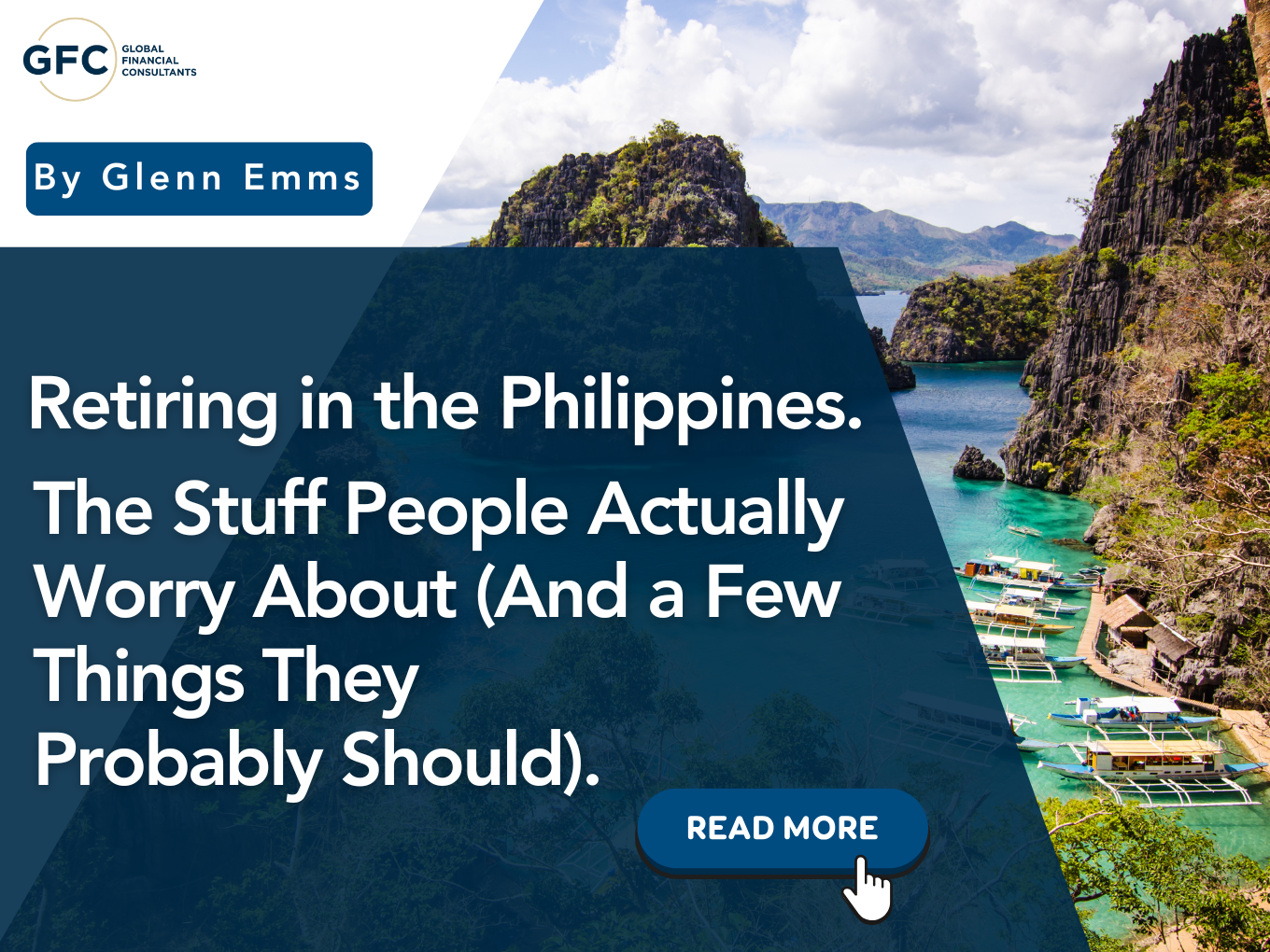
Retiring in the Philippines. The Stuff People Actually Worry About (And a Few Things They Probably Should)
Global Financial Consultants
By Glenn Emms
If you are thinking about retiring in the Philippines, you are probably not losing sleep over whether the beaches are any good. They are.
What tends to keep people awake is whether their money will last, whether pensions will suddenly become taxable, how healthcare really works, and whether they are about to make a costly mistake because someone online confidently said, “don’t worry, it’s all fine”.
This is a straight-talk guide to the issues expats actually care about when retiring in the Philippines. No scare stories. No sales pitch. Just the realities.

A quick word on tax (without the jargon)
Tax is usually the first question and the biggest source of confusion.
At a high level, the Philippines tends to focus on where income comes from, rather than simply where you live. For many retirees, this means overseas pensions and investments are often treated differently from income earned locally.
In practical terms, long-term expats often find that:
- Retirement income is not automatically taxed just because they live in the Philippines.
- Moving money into a Philippine bank account does not, by itself, change the tax position.
- Issues usually arise only where income is earned locally, such as working, running a business, or owning local property.
The key takeaway is that the Philippines does not operate in the same way as countries that tax everything based purely on residency. That said, outcomes depend heavily on individual circumstances and on how things were structured before the move. In many cases, the bigger tax risks sit with a former home country rather than the Philippines itself.
Pensions. How and when to use them
Most people retiring in the Philippines already have pensions or long-term savings elsewhere. The move does not change how those pensions work, but it often changes what makes sense.
Common issues we see include:
- Drawing income flexibly rather than locking into rigid patterns.
- Managing currency risk when income is paid in GBP, USD or AUD but spending is in pesos.
- Holding on to legacy pension structures that made sense years ago but no longer fit life today.
This is not about clever tricks. It is about making sure your retirement income works in the real world, not just on a statement.

Healthcare. Affordable, but not something to wing
Healthcare is another big concern and rightly so.
Private healthcare in the Philippines is relatively affordable, particularly in major cities such as Manila and Cebu. Quality varies by location, and serious treatment can mean private hospitals or treatment overseas.
Most well-prepared retirees:
- Budget for private healthcare rather than relying on public provision.
- Keep medical insurance in place for as long as possible.
- Plan for higher costs later in life, not just the early years.
Healthcare rarely breaks a retirement plan at 60. It often does at 75.
A few topical realities worth knowing
Anyone who has spent time in expat forums will know that the Philippines is often described as either a retirement paradise or an administrative nightmare. As usual, the truth sits somewhere in the middle.
First, the cost of living is still attractive, but it is no longer uniformly cheap. Manila, Cebu and popular expat areas have all seen higher rents, utilities and private healthcare costs over the last few years. The Philippines still offers good value by international standards, but where you live and how you live matters more than it used to.
Second, healthcare expectations need to be realistic. Big-city private hospitals continue to improve and are generally good value compared with Western countries. Outside the main centres, standards can vary significantly. Many retirees now plan on living day-to-day in the Philippines while keeping the option of treatment abroad for more complex issues.
Third, visa rules are relatively stable, but the process is still bureaucratic. Long-term retirement visas remain available and popular. The rules are not the problem. The paperwork, processing times and occasional inconsistency still are.
Fourth, property ownership is widely misunderstood. Foreigners cannot directly own land, and while legal structures exist, assumptions often do not match reality. Buying property without proper advice can create complications later, particularly when it comes to estate planning.
Finally, more retirees are thinking about flexibility rather than permanence. Since the pandemic, there has been a noticeable shift towards keeping a Plan B. That usually means avoiding over-commitment, keeping assets portable, and not structuring everything on the assumption that one country will be home forever.
None of these points are deal-breakers. They are simply the current realities.
Visas. Important, but not a financial strategy
Long-term visas matter because they allow you to stay in the country without constant renewals.
What they do not do is determine how your pensions are taxed, how investments should be structured, or whether a plan is suitable. Visa status and financial planning are related, but they are not the same thing.

Estate planning. The bit everyone puts off
If you hold assets in the Philippines, such as bank accounts or property, local rules can apply when you die. This can slow things down and complicate matters for family members.
Most problems here are not dramatic. They are administrative, frustrating, and usually show up at exactly the wrong time.
Sorting estate planning across countries is dull. Leaving a mess behind is worse.
The real risks
The biggest risks for expats retiring in the Philippines are rarely about lifestyle.
They are usually planning mistakes:
- Making assumptions about tax without checking.
- Leaving pensions and investments set up for a country you no longer live in.
- Ignoring currency risk.
- Hoping healthcare will somehow sort itself out.
None of these are unusual. All of them are avoidable.
Final thought
The Philippines can be a great place to retire. It is affordable, flexible, and generally kind to people with overseas income. A good retirement here is not about clever tricks or loopholes. It is about structure, realism, and getting the basics right early.
Do that, and the Philippines does exactly what people hope it will.
If you’re an expat seeking personalised financial advice, I’m here to help. Feel free to schedule a consultation with me to explore how I can support your goals and guide you toward long-term financial security.
Glenn Emms is a dedicated insurance, wealth management & investment professional with over 30 years of experience in the offshore industry. Building trust and developing lasting client relationships are an important part of his business, and he achieves this by providing tailored recommendations and ensuring a high standard of ongoing advice no matter where his clients may be based.
Glenn is an Authorised Representative of Global Financial Consultants Pte Ltd – No: 200305462G | MAS License No: FA100035-3)
To learn more about how Glenn may be able to help you, please contact him:
Phone number: +6594359981
Email address: glenn.emms@gfcadvice.com
LinkedIn page: https://www.linkedin.com/in/glenn-emms-870546/
Click here to schedule for a complimentary consultation.
General Information Only: The information on this site is of a general nature only. It does not take into account your individual financial situation, objectives or needs. You should consider your own financial position and requirements before making a decision.
*Please note that Glenn Emms is not a tax agent or accountant and none of the content outlined here should be taken as personal advice. You should consult your tax agent and financial adviser to review your current personal finances and financial goals to consider whether this strategy is appropriate for you.